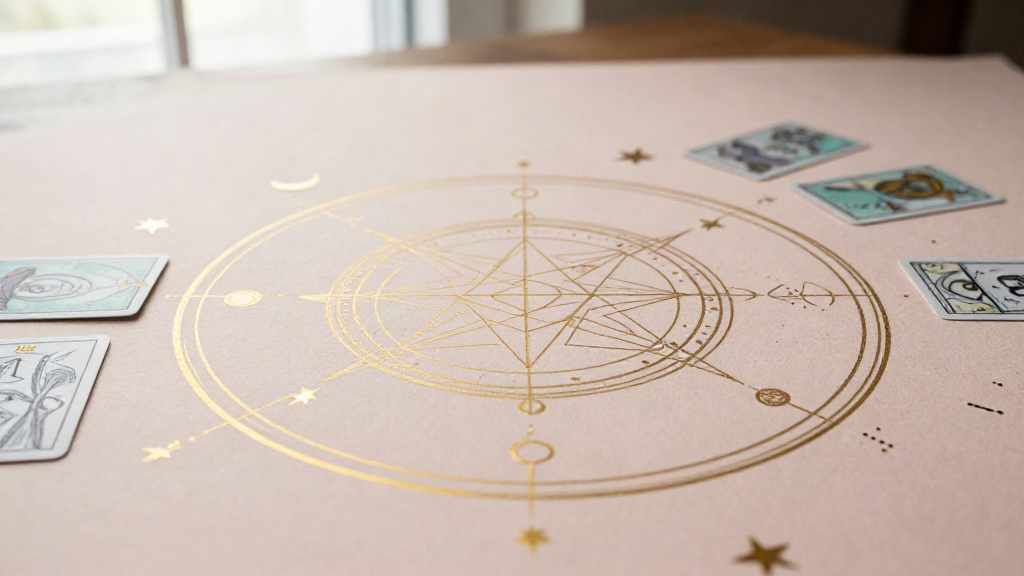
What Is a Destiny Matrix Chart? A Beginner's Guide
If you have been circling the words "destiny matrix chart" for a while without quite knowing what sits behind them, this guide is for you. No prior astrology knowledge is assumed. By the end you will know what the chart contains, where the numbers come from, and what the 22 arcana actually describe.
The short version: a destiny matrix chart is a diagram built entirely from your date of birth. It plots a set of numbers on a geometric grid, and each number maps to one of 22 archetypes borrowed from the tarot. Read together, those points describe your temperament, your recurring patterns, the work you seem built for, and the phases of your life that matter most.
What a destiny matrix chart actually contains
The chart is not a single number or a paragraph of fortune-telling. It is a map with a fixed structure:
- Eight main points around the outer edge, each one an energy you express outwardly.
- Inner points, which show how those energies interact and where they clash.
- A center, usually read as the core lesson or the theme you keep returning to.
- An ancestral square, which covers inherited patterns from your family line.
- Purpose lines, including the personal purpose and the broader social purpose.
- Money and love channels, each read as a separate line of the chart.
- A map of years, which places the arcana on a timeline so you can see which periods carry which themes.
In a full reading all of these are calculated from your birth date and presented together. That is why a proper chart runs several pages rather than one line.
How the destiny matrix differs from a horoscope
A horoscope is cast from a moment in time and place: your birth date, but also the hour and the location, because it needs the positions of the planets. A destiny matrix chart uses only the date itself. No birth time, no city, no ephemeris.
That difference shapes what each one is good for. Astrology describes how planetary placements shape temperament and timing. The matrix describes patterns in a more symbolic, number-based way, and it leans on archetypes rather than planets and houses. If astrology feels like learning a foreign grammar, the matrix is closer to reading a diagram: each position on the grid has a name and a meaning, and the meaning stays the same from chart to chart.
It also means the matrix is easy to reproduce. Anyone with the same birth date sees the same base chart, which is part of why it spreads so quickly between friends and partners comparing their readings.
How your birth date becomes the eight points
The arithmetic is simpler than it looks. Each number in your birth date is reduced by adding digits together until the result lands between 1 and 22, and that result is then placed on a specific position in the grid.
Take a birth date of 14 March 1990, written as 14.03.1990. The day gives 14, which stays as it is because it already sits in range. The month gives 0 + 3 = 3. The year, 1990, adds to 1 + 9 + 9 + 0 = 19. Those three numbers become three of the outer points, and further additions built from them fill in the remaining positions: day plus month, month plus year, the sum of those two, and finally the totals that sit at the center.
Two rules matter here. The first is that nothing is rounded or averaged; every point is a whole number from 1 to 22. The second is that when a sum passes 22, you subtract 22 rather than continuing to break it down. For example, 25 becomes 3. Beginners often miss this and end up with a different chart than the calculator gives them.
The 22 arcana, in plain language
Each number from 1 to 22 corresponds to one arcana. You do not need to memorize all of them to read a chart, but knowing the general territory helps you understand what a reading is telling you.
The first group, 1 through 7, covers the self and how you move through the world:
1, the Magician: initiative, skill with words, the ability to start things from nothing. 2, the High Priestess: intuition, quiet knowledge, timing. 3, the Empress: care, fertility of ideas, making a place feel alive. 4, the Emperor: structure, responsibility, the will to hold a system together. 5, the Hierophant: tradition, teaching, the rules you inherit. 6, the Lovers: choice, attraction, the values that decide who you let close. 7, the Chariot: drive, direction, the discipline of moving toward a goal.
The second group, 8 through 14, covers how you relate to other people and to circumstance:
8, Justice: fairness, cause and effect, the consequences you accept. 9, the Hermit: solitude, study, the search for your own answer. 10, the Wheel of Fortune: cycles, luck, the turn of events you did not arrange. 11, Strength: steady courage, patience under pressure. 12, the Hanged Man: pause, a change of viewpoint, giving something up to see clearly. 13, Death: endings that clear space, transformation rather than literal loss. 14, Temperance: balance, moderation, blending opposites into something workable.
The third group, 15 through 22, covers the deeper tests and the wider horizon:
15, the Devil: attachment, appetite, the patterns you repeat knowingly. 16, the Tower: sudden disruption, structures falling so something honest can be built. 17, the Star: hope, repair, quiet renewal after difficulty. 18, the Moon: uncertainty, imagination, fears that turn out to be fog. 19, the Sun: clarity, visibility, ease that comes from being yourself. 20, Judgement: awakening, a call you finally answer. 21, the World: completion, range, a cycle closing well. 22, the Fool: beginnings, freedom, the willingness to step out without a full plan.
Numbering conventions differ slightly between schools, particularly around positions 8 and 11, so it is worth using one calculator consistently rather than mixing sources.
What a full reading adds
The arcana are the vocabulary. A full chart is the sentence. Once the eight points are in place, a reading connects them: which arcana sit opposite each other, which ones repeat across the money and love lines, where the center lands, and which years on the map of years carry heavier themes.
That is where the useful part appears. A single number tells you very little. The pattern, and the timing, is what makes the reading feel concrete rather than decorative.
A properly built chart gives you the whole set at once: all eight main points, the inner points, the center, the ancestral square, the map of years, and your purposes, money and love channels, delivered as a downloadable reading you keep. Your birth date is used to calculate the chart and nothing else, and access is instant after payment.
Where to begin
Start with your own birth date and see whether the descriptions line up with the way you actually operate. If two or three arcana land immediately, that is the normal sign that the pattern is worth reading in full. If nothing lands, you have lost nothing but a few minutes.
The next step is to read your eight points together rather than one at a time, then check the map of years against the periods you already lived through. Most people find at least one transition that matches something real. That comparison, not the promise of prediction, is what makes a destiny matrix chart worth the time.