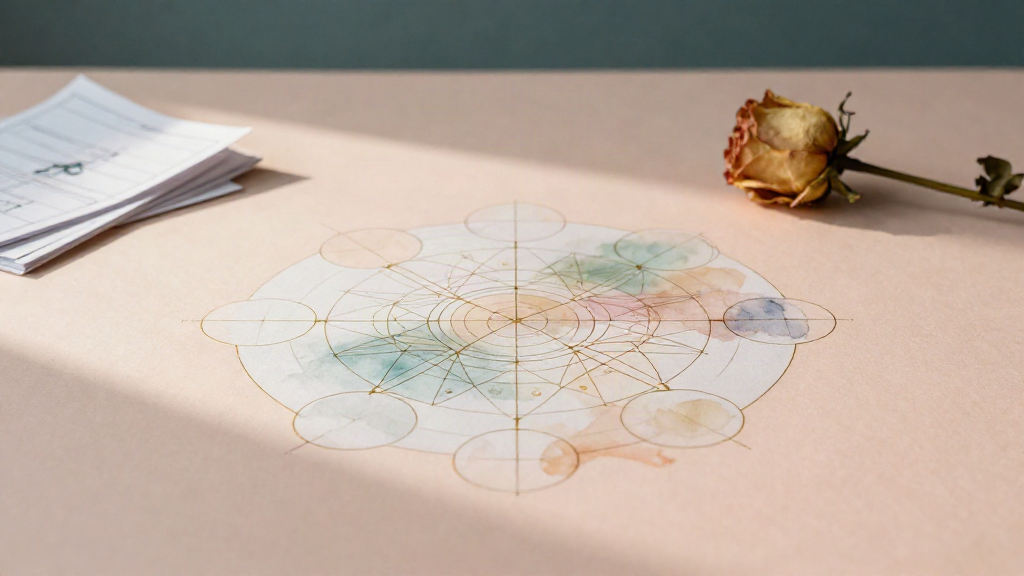
Destiny Matrix Love Line: 7 Relationship Patterns
Most people come to a destiny matrix chart with one question they are too polite to ask first. Not "what is my purpose" but "why does this keep happening to me in relationships." That is a fair question to bring to any self-reflection tool, and the destiny matrix has a specific place for it: the love line.
This article walks through what the love line is, how it is read, and seven patterns people most often recognize in their own once they see it laid out. The goal is not to tell you who you will meet. It is to give you language for what you already do.
What the love line means in a destiny matrix chart
A destiny matrix chart is built from your date of birth and laid out as a geometric diagram of connected points. Each point carries the theme of one of the twenty-two major arcana, and the chart places those themes in a fixed structure: eight outer points around an octagon, inner points, a center, an ancestral square, and separate channels that group points by life area.
The love line is one of those groupings. Its points describe how you attach, what you look for in a partner, and what you tend to repeat once you are inside a relationship. It is not a list of soulmates and it does not forecast a breakup. It reads as a description of your relational baseline - the version of you that turns up when someone matters.
One honest note: different schools place the love line slightly differently, so two charts of the same birth date can look different in the details. A good reading states its method. Ours uses one consistent structure for every chart and is checked against three public calculators before publication.
How the love line is positioned and read
In the chart, the love line runs through a chain of points on one side of the octagon and connects into the center. You read it in two directions: outward, which describes what you want from connection, and inward, which describes how you actually respond when you have it.
The points are read as a sequence rather than as separate scores. A strong point followed by a difficult one often means a preference you hold on to at a cost. Two similar points next to each other usually mean consistency in that area - for better or worse. The center tells you how the whole line resolves, which is why a full chart is more useful than a single point in isolation.
Here are the seven patterns that come up most often when people read their own love line for the first time.
Seven patterns the love line points to
1. Who you show up as before anyone else enters the room
The first point on the line is about your default state, not your behavior in love. It is the self you bring to a first date, a friendship, or a room of strangers. People often find it names a quality they consider ordinary - being the steady one, the funny one, the one who organizes - that other people experience as the reason they feel safe. Naming it matters, because most relationship work starts with knowing what you are already giving.
2. The kind of partner you keep choosing
The second point describes the type you are drawn toward, which is usually not the type that suits you best. The pattern here is about attraction logic: the qualities you read as exciting, competent, or safe, and where those reads came from. It is the point that most reliably produces a wince of recognition. It also explains why advice like "just pick someone nicer" never lands - the pull is specific, and it has structure.
3. Where you mistake intensity for closeness
A common pairing on the love line is a point that values depth next to one that runs hot. When those two sit together, you can end up measuring how much a relationship matters by how much it unsettles you. The reading does not call this a flaw. It suggests the difference you may not have separated yet: intensity is a spike, closeness is a rhythm, and they are not the same thing.
4. The pattern of being needed
Some love line configurations emphasize the point of service, where your sense of worth gets tied to being useful. In relationships this shows up as taking on the emotional labor, fixing, anticipating, and then quietly resenting that nobody asks how you are. The arcana here is about learning to be loved while doing nothing at all, which is harder than it sounds if your whole identity is built around competence.
5. How you handle conflict
The middle stretch of the line usually covers disagreement. You will see one of two shapes: a point that moves toward the problem, or a point that protects the bond by avoiding it. Both are strategies with costs. The moving-toward version can win the argument and lose the evening; the avoiding version keeps the peace and stores the debt. Knowing which one is yours turns a personality trait into a choice.
6. What you do when something gets real
There is a point on the line that behaves like an exit: it describes your response to the moment a relationship stops being hypothetical. Some people commit harder. Some create distance, pick a fight, or start scanning for the flaw that explains why they should leave first. This is often the single most useful point in the entire line, because it tells you how your own protection mechanism looks from the outside.
7. The way you grow in a relationship
The final point closes the line and describes the lesson rather than the situation. It is the version of you that can only be built with another person in the room - patience, honesty, softness, boundaries, whichever the point carries. Read last, it reframes everything before it: the repeated type, the intensity, the conflict style, and the exit are not character defects. They are the material the growth point works with.
Using the reading as reflection, not prediction
A chart cannot tell you whether a specific person is right for you, and it should not be the reason you stay or leave. What it can do is put a name to a pattern you have been living out without a vocabulary for it. That is a small thing, but naming a pattern is usually the step before changing it.
Two practices keep the reading useful. First, write down what you recognize and what you do not. The points that feel flat are as informative as the ones that sting - sometimes they describe a capacity you have not had to use yet. Second, test one pattern in real life. If the line says you avoid conflict, notice the next three moments you swallow a sentence. The chart gives a hypothesis; your week gives the evidence.
It also helps to hold the reading at the right altitude. The destiny matrix is a reflective framework, not a diagnostic tool, and it does not replace a conversation with a partner or a therapist. Treat it as a map you check against the territory, not the territory itself.
What a full chart adds
The love line is one channel in a larger structure, and it is easier to read once you can see the points it connects to - the center, the ancestral square, and the money and love channels that run alongside it. A full Karmatrix Destiny Matrix Chart covers all eight main points, the inner points, the map of years, and both channels, delivered instantly as a downloadable reading after payment. Your birth date is processed in your browser and never stored, so the only thing you are sharing is the question you came with.